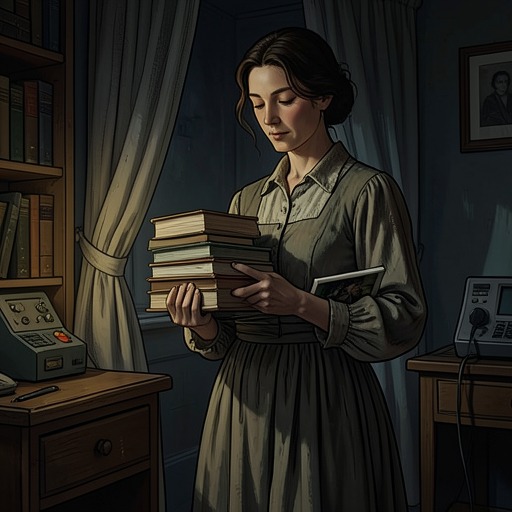
Nedra Frank
I Know This Much Is TrueNedra Frank is the graduate student entrusted with translating Domenico Onofrio Tempesta’s manuscript, a family history Dominick Birdsey hopes to give Ma as she is dying. The commission begins as an act of filial care and becomes a lasting grievance: Nedra’s disagreements with Dominick over the manuscript’s language and the terms of translation are followed by her withdrawal from university and the disappearance of the work. Because the manuscript is both a record of the family and a gift Ma never receives, Nedra’s brief role exposes how fragile Dominick’s access to his own history can be.
Identity and Introduction
Nedra enters the story as the final name on a list of possible translators supplied by the university’s Department of Romance Languages. Dominick finds her office at the top of a stone building, reached by narrow steps and overshadowed by two large, leafless beech trees. She is a graduate student sharing an office with another student; the contrast between her untidy desk and his neat one catches Dominick’s attention before he has any sense of her approach to the work.
Her first response to the manuscript is a judgment about its difficulty. Some pages are in standard Italian, while others appear to be written in peasant Sicilian. She asks whether its author was schizophrenic, a question Dominick experiences as an insult rather than a useful inquiry. Nedra identifies herself as a scholar and objects to treating translation as a decorative service, comparing Dominick’s request to asking a serious artist to make a painting that matches a sofa and drapes. Her objection establishes both her professional self-conception and the mismatch between their expectations: Dominick wants a readable family keepsake, while Nedra sees a complicated scholarly undertaking.
The Translation Commission
Nedra does not simply refuse the job. She proposes a price that distinguishes the manuscript’s different forms: eight dollars per handwritten page, sixteen per typed page, and an additional five dollars for each necessary explanatory footnote. She tells Dominick that she wants four hundred dollars up front and estimates that the translation will take a month or two, given what she calls her oppressive schedule. Dominick writes the check, though he worries that she may abbreviate or omit pages despite the cost. The project therefore begins with a practical agreement shadowed by his fear that the translator will control what survives of the family record.
Nedra’s account of her method gives the commission a cultural and interpretive dimension. She intends to leave some Italian words and phrases untranslated so that a reader can sense the language’s music, and to retain difficult proverbs with parenthetical approximations rather than claim exact equivalents. She plans to preserve very little of the Sicilian, describing that choice as weeding a garden. The approach is neither a wholly literal transfer nor a promise to reproduce every linguistic distinction: it makes the Italian’s sound and certain expressions visible while allowing much of the Sicilian to be removed. Dominick’s later suspicion that she might shortchange him thus concerns more than the number of pages; it also concerns which parts of Domenico’s voice her decisions will preserve.
Disagreement and Personal Judgment
Dominick calls Nedra several times over the following weeks to ask about progress or answer possible questions, but gets no response. When they speak again, she explains her choices about the Italian, proverbs, and Sicilian. The exchange occurs on a day Dominick describes as brutal, when he has little patience for her scholarly detachment. He asks her to give the manuscript an emotional reaction for his sake, pushing the professional conversation toward a personal verdict on its author.
Nedra answers that she dislikes Domenico: she considers him pompous, misogynistic, and horrible. Dominick, who had been insisting on the importance of the grandfather whose life she was translating, falls silent. Nedra then points out that he has become offended and says she should not have given up her objectivity. The moment complicates her role. She is not merely a neutral instrument transmitting a dead man’s words: she has read enough to form a strong moral judgment, and she knows that giving that judgment voice has altered her relationship with the person who commissioned the work. At the same time, her insistence on objectivity sits uneasily beside the personal evaluation she has just offered.
Withdrawal and the Missing Manuscript
By the time Dominick returns to the university in mid-April, Ma’s cancer has worsened and he has found little time or emotional capacity to pursue the translation. He goes to Nedra’s office wanting the manuscript back, whether or not the work is complete. Her office mate tells him she has withdrawn from the degree program for personal reasons. Her desk has been cleared and the bulletin board stripped bare; the physical absence of her belongings gives Dominick no immediate explanation or route to the pages. When he protests that she has something important of his, the office mate only shrugs.
Dominick understands the disappearance as a betrayal. He later thinks of Nedra as having stolen the manuscript, notes that she cashed his check, and imagines that she may have thrown the work away. He considers trying to locate her through an ex-husband she had said held a senior position at a state hospital, through a police-station contact, or even by hiring a private detective. He also contemplates tracing Angelo, a stenographer connected with that summer, as another possible lead into the family’s past. These are plans rather than successful searches in the evidence presented: the manuscript remains out of his reach, and Dominick’s anger grows from uncertainty as much as from the loss itself.
Narrative Significance
The manuscript’s importance is established before Nedra appears. Ma had saved her father’s history, and Dominick imagines having it translated, printed, and bound so she can read it. The pages include both typed material and extensive handwritten passages; they are not an interchangeable document but the surviving form of a life story that Ma had gathered after finding her father collapsed. For Dominick, their recovery would mean reclaiming a connection to his grandfather as well as fulfilling a promise of care to his mother.
That intended gift is never delivered. When Dominick later explains that the translation took longer than expected, that Ma declined quickly near the end, and that the manuscript was lost, he immediately qualifies the word lost and avoids recounting Nedra’s part in the matter. The qualification preserves the difference between an accident and a disappearance he still regards as a theft, while his reluctance to explain shows that the episode remains painful. Nedra’s limited appearance therefore leaves a substantial absence: she is remembered through a paid commission, contested choices about language, an abruptly emptied office, and a family history that Dominick cannot recover.